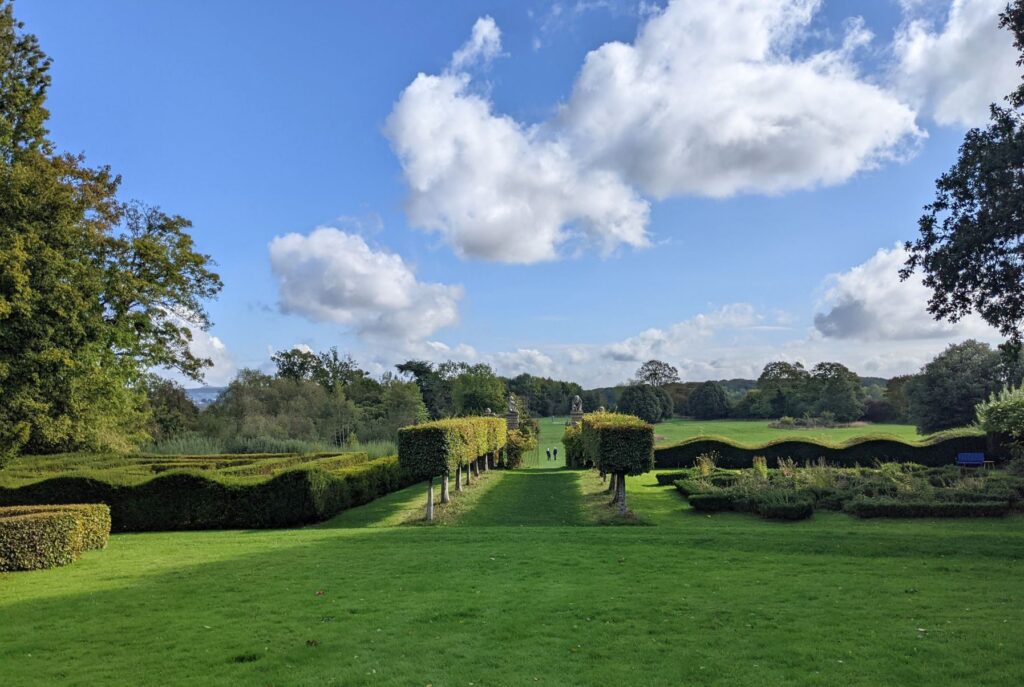
Hellens Manor is an ancient brick house surrounded by gardens that sits about one third along the route of the Daffodil Line if you’re travelling from Ledbury, and the bus stops right outside. True, you have to walk up the drive to the house, but it’s a short walk along a lovely approach called the Monks Way, and by far the best way to arrive.
The house is open Wednesdays, Sundays and Bank Holiday Mondays from April to mid-October, as well as on special events days featuring music, crafts and markets. Great things are also planned for the future, namely a purpose-built art gallery to house the ‘Wharton Collection’.

Hellens House is just that – a house, not a castle – which is curious as most historic houses did begin as castles going back to Norman times or even before, when the land was owned by warlords faithful (or otherwise) to the Monarch. Remember too that Much Marcle in early Norman times lay in the Forest of Dean, which was almost a separate kingdom in those days, between England and Wales. A King would have been anxious to keep it under control and so “William the Conquerer” entrusted the loyal Lord de Balun with this task.
Later the lordship passed to the Mortimers, and the vestiges of their castle in the form of a large mound lies next to the church. Mortimer’s castle was the main holding in Marcle. Hellens was their bailiffs residence. Later when internal warfare was less of a threat, landlords abandoned their uncomfortable and inconvenient castles and built themselves big houses. The Mortimer landowners went to Homme House, and the Hellens family made the home we see today. Remnants of it date back to the 14th century, and it was developed further in the 16th and 17th centuries.
At the time of “William the Conqueror” there were already residents at Hellens – the Monks of Cormeilles, France, who were ordered by William to educate and pacify the west of England. A small group of them made their way to the Forest of Dean, found a well on a rise and made their home there. The drive to Hellens – the Monks Way – follows the route they took daily from the well to the church. This is considered to be the well that exists at the centre of Hellens today.
The church we see was built by the various lords of the manor and parishioners over several centuries. It was situated near a sacred yew tree and the first warlord built his castle next to it. The steward (or bailiff) of the castle was Seneschal Helion, hailing from Helion Bumpstead in Essex, from which “Hellens” derives its name.
Back then, the bailiff was an important person as the main lord was usually absent, and his home and lands reflected this. Hellens is one of the earliest brick houses in England dating back to the 14th century. The owners over the years became wealthy by rents, advantageous marriages and inheritance. Many of the main families of Herefordshire have owned Hellens at one time: the Audleys, Walwyns, Pytts and in the 20th century, Charles Radclyffe Cooke, the MP and cider expert.
Anyone can visit the gardens on the open days, but if you take a House Tour you will learn a lot more. The tour takes an hour and a half and is full of wonder. Walking around the house, you can feel the presence of the people who have lived here, who looked out at the view and enjoyed the gardens and country sounds as we do today. Afterwards you can have tea in the garden… and if you show your bus ticket Hellens will give you a discount on your tea!