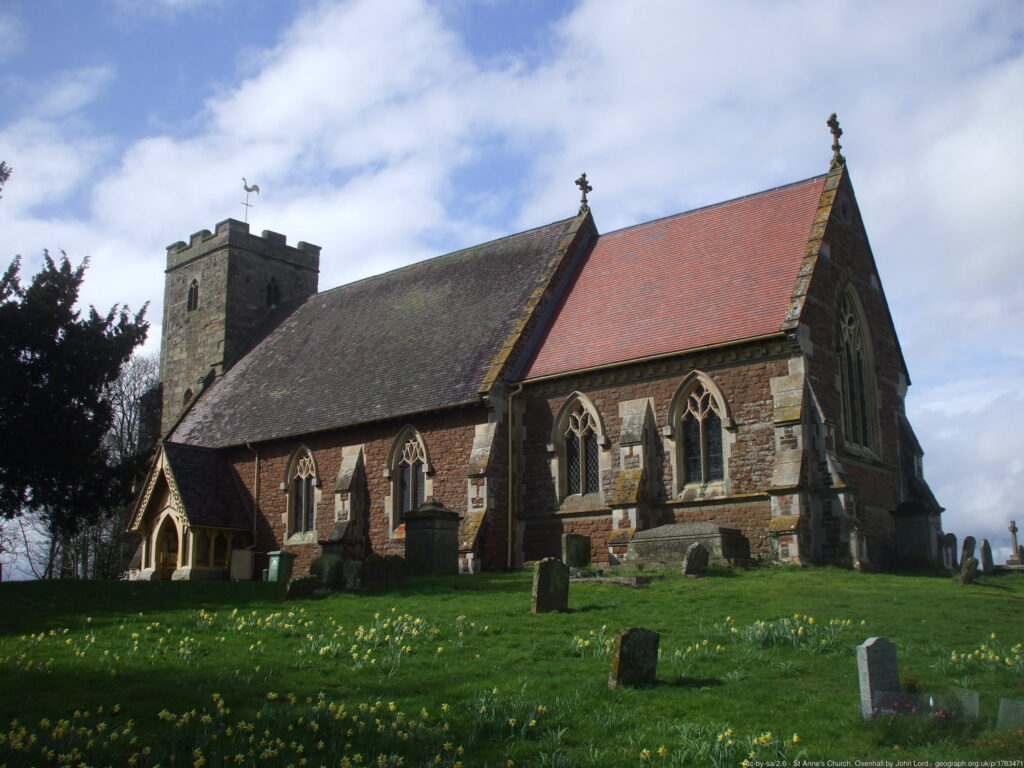
Oxenhall church stands on a hill one mile from Newent in an oval churchyard surrounded by a very large ditch. Because of this ditch and the hill location, I wondered if this church could have been a hill fort, but the ditch looked suspiciously obvious to be that old, and indeed, as I found later, it was not. The big ditch was a canal connecting collieries on the west to the Hereford, Newent, Gloucester canal on the east. The canal was built between 1793 and 1845 and closed in 1885 when the railway (the original Daffodil Line) superseded it.
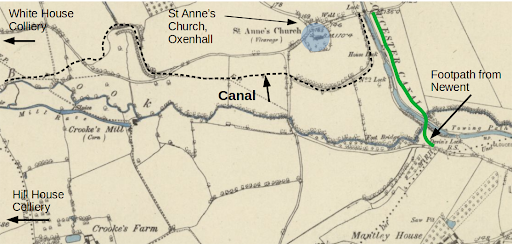
Though no longer functional the old canal is a much loved feature inspiring walkers and historians alike as to how, when and why but is such a big subject, covering iron working, coal digging, tunnels and bankruptcies that it must wait for another article. Today I am writing about St Anne’s Church, which is interesting enough to stand on its own.
I was wrong about the outer ditch being ancient, but I think I am right about the inner one. Look at the map and you will see three roads all meet at the church and on the north side cut the church enclosure. These roads twist and turn to get to St Anne’s so clearly the church was their destination. There was a church here long before any farms or fields around it.
Within the church enclosure is a well and wells and springs are important in Christianity. You can image early missionaries in this hilly woody country of scattered farms and wood working people in the 6th or 7th centuries AD setting up their cross in this prominent place and converting and baptising the people around using the clean precious water mysteriously issuing from the hill top.
The church is dedicated to St Anne, when this happened is not known but it could have been in medieval times. Anne was the mother of Mary, not mentioned at all in the bible but only in later texts. She was sanctified by the 7th century
Though St Anne’s is an early site, the church building we see today is not. The earliest part that survives is the stunning lead font which is dated to the 12th century, around the time of the wars of Stephen and Matilda, (Matilda was the granddaughter of William the Conqueror who lost the battle but won the war for her son became Henry II). No doubt a stone church stood here then but over the centuries it became dilapidated. By the 1860s it was in a very sorry state, with walls leaning and the interior crumbling and something had to be done.
The vicar of the time, the Rev Little was the man to organise it. He inspired the main landowners, the Foleys and Onslows (who by this time had become the Foley Onslows) and the Tennants of Upton who were connected to the parish and various charities to donate the money. A new church was designed by architects from Cheltenham and built by builders from Stroud. They used stone from a local quarry combined with the usable stone from the demolished church and carving and ornamental stone from Painswick (20 miles away), and Caen in France and ‘Forest’ stone (from the Forest of Dean), while the roof, doors and fittings were of varnished ‘deal’ (Scots Pine).
The tower was not demolished but was thoroughly repaired by local labourers. The result is a very pleasing building, set in an ancient place and is an easy walk for Daffodil users from Newent. The church is generally locked but is open from 10.00am to 12 noon on the second Saturday of the month for a coffee morning (including bacon sandwiches) and for the hall Coffee Morning on the third Thursday in the month, it will also be open for the Daffodil weekend on the 22nd and 23rd of March, and serviced by the Daffodil shuttle, for those of you who don’t fancy the walk from Newent.